

Day 13: Continuity and Discontinuities
- locusfocusmath
- Aug 17, 2021
- 2 min read
Updated: Aug 19, 2021
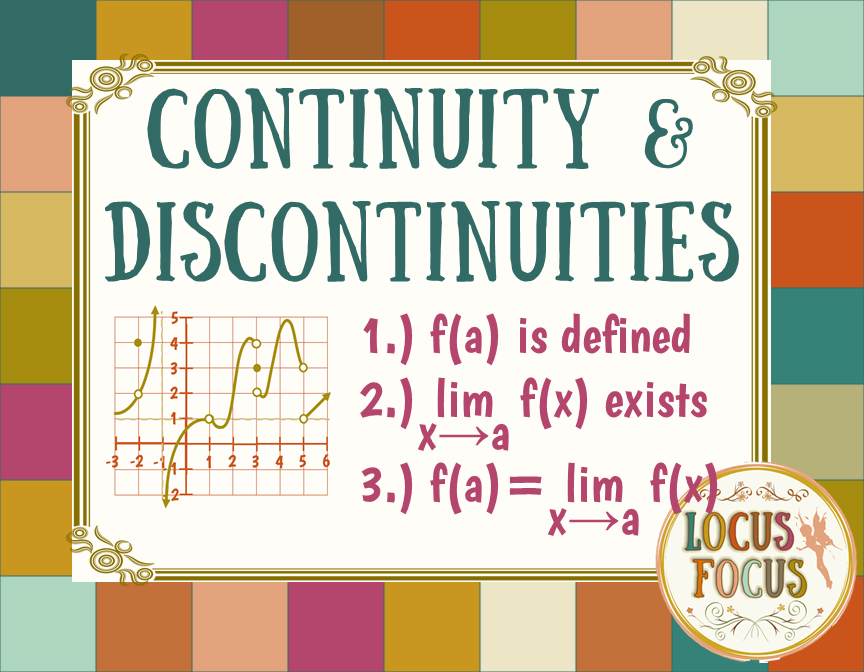
So the first thing I teach on this day is that there are 3 types of discontinuities: Infinite (Vertical Asymptote), Jump (when the graph jumps up or down and continues somewhere else), and Removable (when there's a hole in the graph).
I like to include the informal definition of continuity (that you can draw it without picking up your pencil) and the formal definition of continuity at a point: the function f(x) is continuous @ x = a if the three conditions (see image) are met. With the definition, you can go immediately into which types of limits indicate which type of discontinuities:
a.) If the lim as x-->a of f(x) = ∞ or -∞, then that's an infinite discontinuity
b.) If the lim as x-->a from the left doesn't equal the lim as x-->a from the right, that's a jump.
c.) If the lim as x-->a of f(x) doesn't equal f(a), then that's removable.
When I was getting certified to teach calculus in 2010, my instructor told us that he uses an analogy of bridges (to represent f(a)) and roads on either side of the bridge to represent the lim as x-->a from the left and right. I actually laminated a bridge and roads and glued magnets on the back of them. Instead of pin the tail on the donkey, we played pin the bridge between the roads. I blindfolded my students and spun them around and had them attempt to put the bridge and the two roads on the board. Whether they were successful or not, the rest of the class had to use limits to explain their attempt. It was fun and memorable which comes in handy later when you're reviewing for the AP exam.
Lastly, there are those problems that have become tradition: find the value of k that makes f(x) continuous where f(x) is usually given as a piecewise function. I think every textbook includes them. f(x) is possible a jump or a removable and there's no rule calculus involved in these problems. You just set the two pieces equal to each other at x = a and solve for k. Normally it's just a quick linear equation that students can solve in their head, but those problems became popular with college board all the same.

Comments