

Day 16: Limit Definition of a Derivative
- locusfocusmath
- Aug 17, 2021
- 2 min read
Updated: Aug 19, 2021
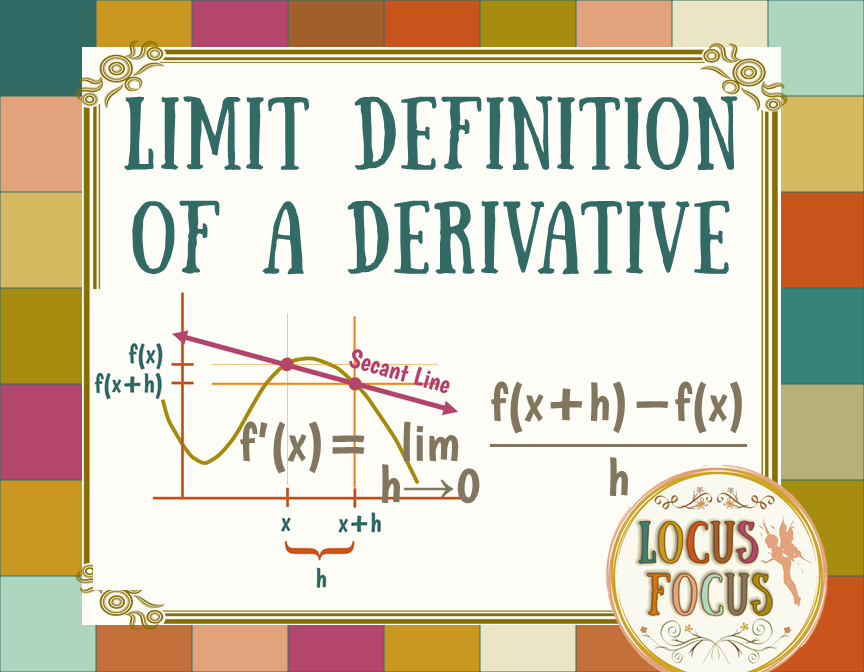
So since I just taught L'Hôpital the day before, derivatives are fresh in their minds. Again, they should know the derivative of sin(x), cos(x), e^x, and how to differentiate polynomials. So I am limited to showing them problems with only these functions to start today's lesson. I tell them that these limit imposter questions are actually derivative problems IN DISGUISE. I show them how the secant line becomes the tangent line and how we get lim h-->0 of [(f(x+h) - f(x)]/h. I actually show them this problem in my summer assignment, so they are very comfortable with it and even have aha moments pertaining to whatever they were wondering about when we started the course with it. So after I show them questions like lim h-->0 of [sin(x+h) - sin(x)]/h, they're feeling good. They think these questions are easy! And ya know what? That's great because when these questions are on the AP exam, they ARE easy! All the students have to do is recognize that they are being aske for a derivative.
Anyway, and then I ruin the party.
I then show them the OTHER definition of a derivative at a point namely f'(a) = lim x-->a of [f(x) - f(a)]/(x - a). I make them work it out. Ew. Gross. And then I make them not only give me the slope of the tangent but the whole equation of the tangent line, but they're usually good with that part.
Then I make them work out the h-->0 problems a couple of times. I've heard of some teachers that skip this because the problems are too tedious to put on the AP exam, but A.) I'm not teaching to the test and B.) What if there are questions about the process of working them out on the AP exam? Besides I think the students feel pride when they work out a big a problem like that and get the answer (especially the polynomial problems since they can just use the power rule to check their work). The only h-->0 problem I have them work out are polynomials, square roots (so they have to use the conjugate again), and derivatives of easy rational functions. One of each in the notes and one of each for their homework.

Comments