

Day 11: Limits and Asymptotes
- locusfocusmath
- Aug 9, 2021
- 2 min read
Updated: Aug 19, 2021
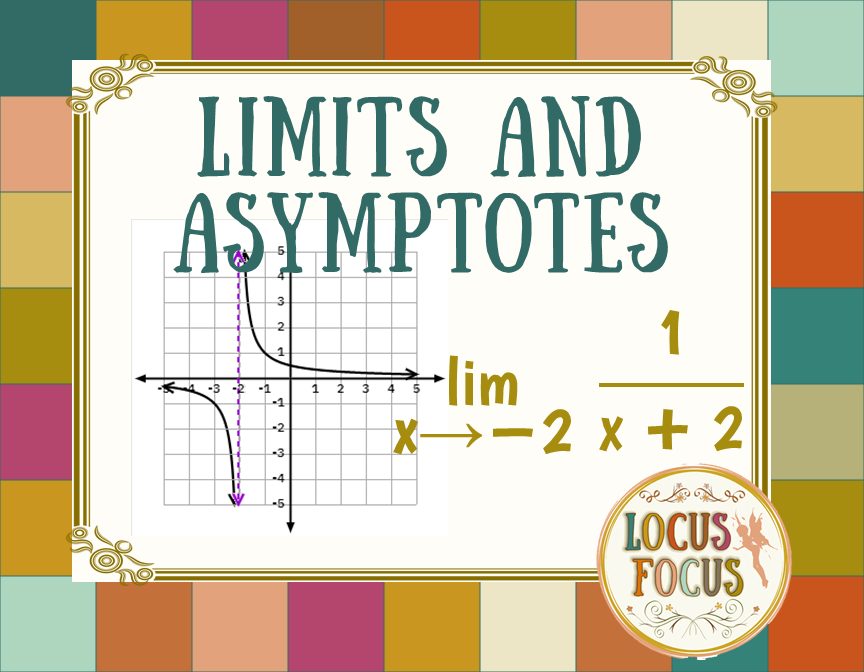
So this is the first day of doing limits with infinity. What I first tell them is where the infinity goes with each type of problem. If it's a vertical asymptote statement, you have to make sure the limit problem actually equals infinity or negative infinity. If it's a horizontal asymptote statement, the limit must approach infinity or negative infinity.
Vertical Asymptotes: The next thing they need to get clear on is limit math because they're not used to dividing by zero and infinity. A constant divided by any type of infinity is zero. Yay! Easy. A positive constant divided by a positive zero-ish number is positive infinity while a positive constant divided by a negative zero-ish number is negative infinity. That should be easy too, but it's new to them (and kinda cool - at least I act all excited by it, lol).
There are a few different types of vertical asymptote limit problems that don't result in DNE and that's when we have a way to guarantee positive zero-ish numbers in the denominator. Off the top of my head: 1.) when the denominator is a even powered polynomial, 2.) when there's an absolute value around the denominator, 3.) when there's a trig function in the denominator like 1 - cos(x) while x approaches zero. Those are all definitely going to give you a positive zero-ish number in the denominator.
Horizontal Asymptotes: 1.) Exponential functions have one horizontal asymptote and one end that either approaches infinity or negative infinity. Some students learned end behavior in trig class. 2.) Rational functions are my favorite because if they have a horizontal asymptote, it's the same one on both ends. 3.) And finally "Other" functions like my favorite example of inverse tangent because it has two different horizontal asymptotes.
Note#1: Did you know that inverse cotangent is not completely agreed upon? If you go to Wolfram Alpha, they use -pi/2 to pi/2 as its range while Desmos uses 0 to pi. When teaching pre-calculus, I stay away from too many inverse cotangent compositions because it's just not fair to them.
Note#2: It's important they hear you actually say that a function can ever only have two horizontal asymptotes. They get one from doing the limit as x --> ∞ and they get the other from doing the limit as x --> -∞. They should always check both sides UNLESS they know the function and it's behavior well already (for example they should know exponential and rational functions).
And that's it really. There are some good problems on past AP exams where students had to find the limit of both positive and negative infinity on FRQs, but I can't remember the exact years or questions.

Comments